A psychological account of why things sometimes feel extraordinarily special, enchanted, glamorous, sacred, nostalgic, or uncanny
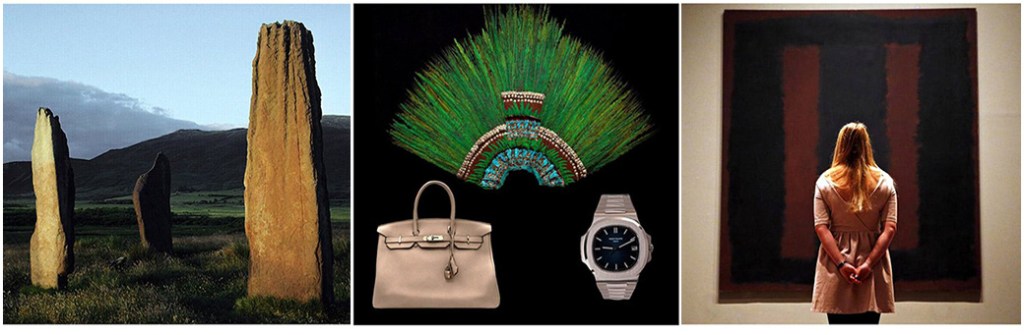
What is hagioptasia?
Hagioptasia (hag-ee-op-TAY-zha) is a proposed perceptual process through which certain people, places, objects, or memories come to feel extraordinarily significant or special. A distinctive feature is that the specialness can seem to belong to the thing itself — as though it were radiating from the person, place or object, rather than simply being recognised as a response occurring in one’s own mind.
This perceptual shift can be subtle or intense.
It underlies experiences often described as:
- sacredness or spiritual atmosphere
- awe or reverence
- glamour and ‘iconic’ presence
- artistic profundity
- nostalgia and the sense of a ‘golden past’
- spookiness, eeriness, and the uncanny
What links these experiences is not their emotional tone, but a shared underlying change in perception.
A familiar but unnamed experience
Many people recognise the experience once it is described. Whether these experiences are best understood as manifestations of a single psychological process, however, remains an empirical question.
It is present when:
- a place from childhood seems to glow with remembered depth
- an artwork or object feels as if it possesses an aura
- an ordinary room takes on an uncanny atmosphere
- a person appears unusually compelling or important
- a landscape feels spiritually charged
- something feels “off” or “wrong” though nothing obvious explains it
These impressions can be powerful, yet difficult to articulate.
Hagioptasia gives the experience a name and structure.
Where to start
If you’re new to the idea, these are good places to begin:
- The short introduction — a concise overview of the mechanism
- The phenomenology — how to recognise and identify hagioptasia
- Examples — everyday cases from memory, art, religion, and the uncanny
- Research background — theoretical foundations, empirical findings, and ongoing research
Why it matters
If hagioptasia is a genuine psychological process, it may help explain why certain people, places, objects, memories and ideas acquire an unusual sense of significance.
The distinction between something being meaningful to us and something seeming to possess a special quality of its own may be particularly important. The latter experience can influence attention, desire, memory and behaviour, even when we recognise that the perceived specialness is not an objective property of the stimulus.
Understanding this process may eventually help explain phenomena ranging from nostalgia and aesthetic experience to fascination, sacredness, glamour and the uncanny. But determining how far these apparently different experiences really share a common mechanism is one of the central questions for future research.
About the research
Hagioptasia was originally proposed by Daniel Laidler and subsequently developed in collaboration with psychologist John A. Johnson.
In 2020, Johnson and Laidler published the first empirical study of hagioptasia in Personality and Individual Differences. The study explored whether individual differences in the proposed construct could be measured using a questionnaire. The findings provided preliminary support for the construct, while also identifying important limitations in the original measure.
Research is now focused on a more specific question: does the experience of perceiving something as possessing a special quality of its own represent a psychologically distinguishable phenomenon?
Current work is therefore examining whether hagioptasia can be distinguished from related experiences such as:
Awe — feeling overwhelmed or impressed by something extraordinary
Nostalgia — feelings associated with the personal past
Aesthetic sensitivity — responsiveness to beauty and aesthetic qualities
Curiosity and novelty — interest in unusual or unfamiliar things
Status-related responses — attraction to prestige, fame or social standing
A central focus is the proposed experience of externalised specialness: the feeling that something seems special not merely because it matters to us, but because the specialness seems somehow to belong to the person, place or thing itself.
The aim is not simply to show that people sometimes find things meaningful or special. It is to determine whether the distinctive experience described by hagioptasia can be reliably measured and whether it adds explanatory value beyond existing psychological concepts.
The evidence remains preliminary, and important questions are still open. Hagioptasia is therefore best regarded as an ongoing empirical hypothesis and research programme, rather than an established psychological theory.
Further reading
Johnson, J. A., & Laidler, D. (2020). Measuring hagioptasia: A case study in theory-testing through Internet-based personality scale development. Personality and Individual Differences, 159, 109919.
Laidler, D. (2025). Hagioptasia: Convergent Evidence for a Unified Construct of Perceived Specialness. Zenodo.
 Hagioptasia