A psychological account of why things sometimes feel extraordinarily special, enchanted, glamorous, sacred, nostalgic, or uncanny
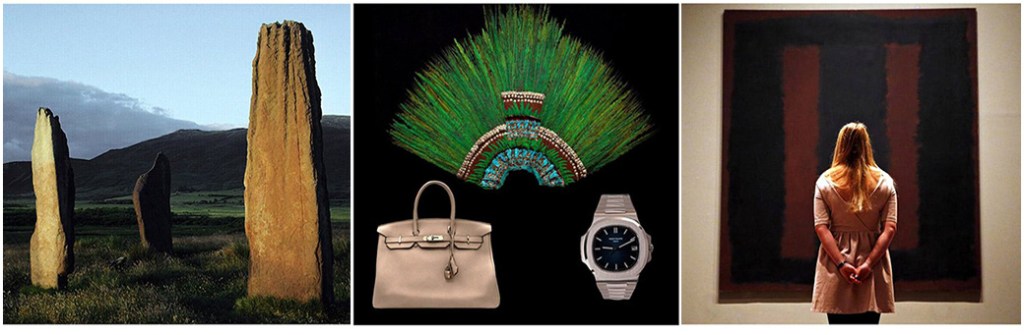
What is hagioptasia?
Hagioptasia (hag-ee-op-TAY-zha) is a perceptual mechanism that makes certain people, places, objects, or memories appear charged with significance.
It creates the impression that ‘specialness’—or wrongness—is in the thing itself, radiating outward, rather than arising from one’s own mind.
This perceptual shift can be subtle or intense.
It underlies experiences often described as:
- sacredness or spiritual atmosphere
- awe or reverence
- glamour and ‘iconic’ presence
- nostalgia and the sense of a ‘golden past’
- spookiness, eeriness, and the uncanny
What links these experiences is not their emotional tone, but a shared underlying change in perception.
A familiar but unnamed experience
Most people recognise hagioptasia immediately once it is described.
It is present when:
- a place from childhood seems to glow with remembered depth
- an artwork or object feels as if it possesses an aura
- an ordinary room takes on an uncanny atmosphere
- a person appears unusually compelling or important
- a landscape feels spiritually charged
- something feels “off” or “wrong” though nothing obvious explains it
These impressions can be powerful, yet difficult to articulate.
Hagioptasia gives the experience a name and structure.
Where to start
If you’re new to the idea, these are good places to begin:
- The short introduction — a concise overview of the mechanism
- The phenomenology — how to recognise and identify hagioptasia
- Examples — everyday cases from memory, art, religion, and the uncanny
- Research background — theoretical foundations, empirical findings, and ongoing research
Why it matters
Hagioptasia describes a perceptual process that can strongly influence what people experience as meaningful, desirable, or important.
When this mechanism is active, certain things can feel uniquely significant — as if they promise depth, fulfilment, or authenticity. Yet these impressions are not always reliable guides to what will actually satisfy, endure, or matter in the long term.
By making this process visible, hagioptasia helps explain why individuals and cultures often become drawn to people, objects, ideals, or pasts that feel profound but often fail to deliver what they seem to promise.
Recognising the mechanism can bring greater clarity about desire and motivation, allowing expectations to be examined rather than simply followed. In doing so, it can also support a more grounded appreciation of what is genuinely available, attainable, and sustaining.
About the research
Hagioptasia is a psychological theory originally articulated by Daniel Laidler, an independent researcher examining how humans experience perceived specialness, sacredness, glamour, nostalgia, and uncanny presence.
The theory was empirically validated in a 2020 peer-reviewed study co-authored with Professor John A. Johnson, establishing hagioptasia as a measurable psychological construct.
Research on hagioptasia includes, and invites further work on:
- theoretical integration with related constructs such as awe, sacredness, liminality, enchantment, and status perception
- psychometric measurement, including the first validated hagioptasia scale (3,000+ participants)
- phenomenological analysis of lived experience
- historical and cross-cultural perspectives on perceived specialness and presence
- applications across domains including art, religion, memory, and symbolic value
Further reading
Johnson, J. A., & Laidler, D. (2020). Measuring hagioptasia: A case study in theory-testing through Internet-based personality scale development. Personality and Individual Differences, 159, 109919.
Laidler, D. (2025). Hagioptasia: Convergent Evidence for a Unified Construct of Perceived Specialness. Zenodo.
 Hagioptasia